
AI in Outsourcing: How It’s Shaping the Industry’s Future
Is outsourcing still just about saving money, or has it become something much bigger?
The outsourcing industry is going through a quiet but powerful shift. Jobs that previously required large teams and lengthy working hours are now completed faster, more efficiently, and with fewer mistakes. The reason is simple: AI has stepped in.
Businesses nowadays do not just outsource for support functions. They outsource for agility, precision, and sharper insights. AI is revolutionizing outsourcing, reshaping the expectations of businesses, and changing how value is delivered. And this revolution isn’t coming; it’s already here.
So, let’s break down how AI is redefining outsourcing and what this shift really means for businesses moving forward.
How Is AI Redefining Outsourcing?
Outsourcing is no longer limited to handing over repetitive tasks and waiting for results. With AI, outsourcing has become more proactive, faster, and far more reliable.
AI helps outsourcing teams automate routine work, reduce manual effort, and make smarter decisions using data. Things like data entry, report generation, customer queries, and process monitoring can now happen in real time, with minimal delays and fewer errors.
What is more, AI gives outsourcing partners the freedom to evolve from task performers to strategic advisers. Rather than just executing directives, AI-enabled outsourcing teams are capable of warning businesses of potential problems, enhancing workflows, and assisting them in being proactive rather than reactive.
Key Impacts of AI in Outsourcing
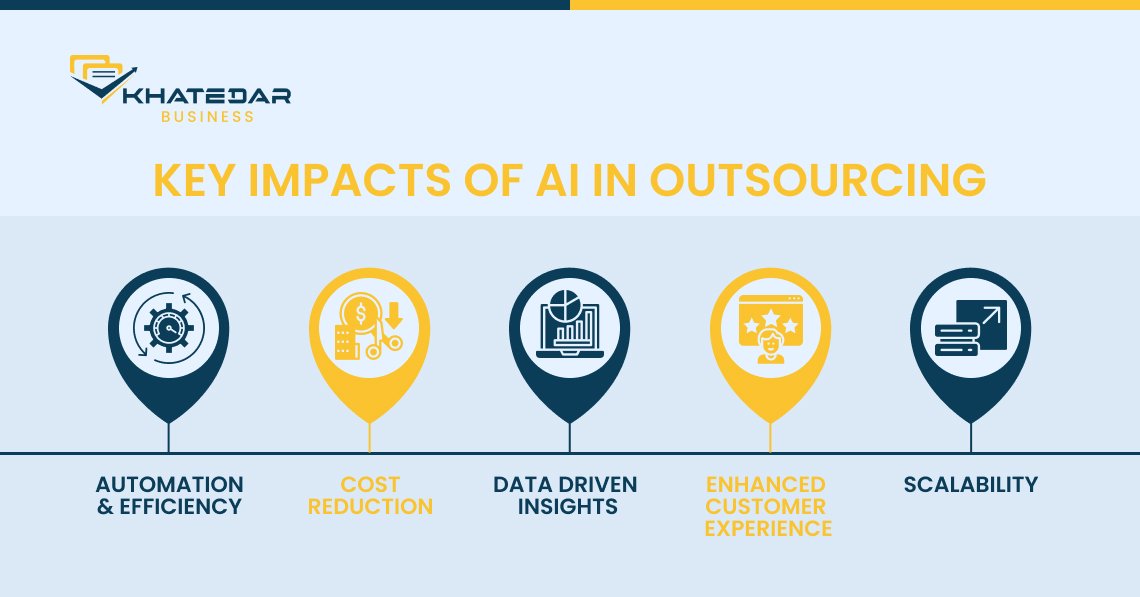
1. Automation & Efficiency
AI helps in automating the repetitive parts of the job, like data entry, report generation, customer queries, and workflow management. It means a lower manual workload and much faster daily operations. Less work, more accuracy, and higher consistency are some of the benefits of an efficient team. In short, employees get more time to solve problems and do value-adding work.
2. Cost Reduction
AI reduces the cost of outsourcing since it reduces the dependence on manual labor. Less rework means less time and money used, and that’s one of the ways AI reduces errors. AI tools also help in optimizing the usage of resources so that the most efficient way to do a task is chosen. Over time, this leads to noticeable cost savings for outsourcing operations.
3. Data-Driven Insights
AI can handle massive amounts of data without breaking a sweat and with great accuracy. It identifies trends, patterns, and performance gaps that humans may miss. The insights gained from this data help the outsourcing provider to enhance the way they work and give more advice to the clients. Real-time data-driven decisions have replaced assumption-based ones.
4. Enhanced Customer Experience
AI-powered chatbots and support systems provide instant responses to customer queries. They ensure consistent communication and reduce waiting times. AI also determines customer behavior and previous data, paving the way for personalized interaction. The result is a smoother customer journey and enhanced brand trust.
5. Scalability
AI allows outsourcing operations to scale without disruption. When workload increases, AI systems can take on increased workloads, process higher volumes, and be more efficient than humans. This flexibility makes outsourcing more reliable and future-ready.
Benefits of AI in Outsourcing
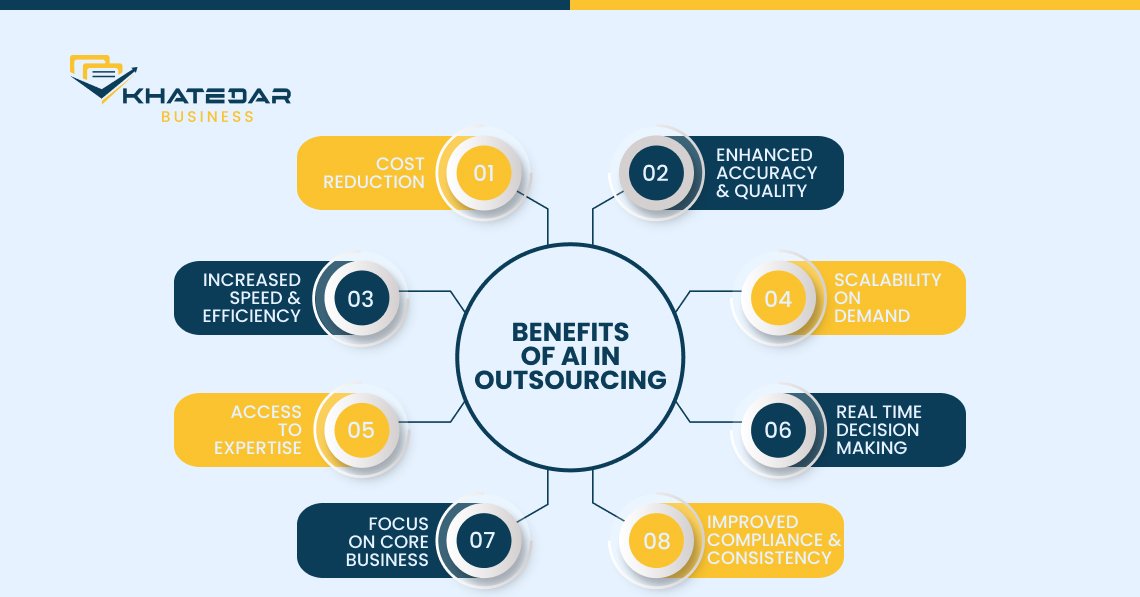
Cost Reduction
AI helps businesses bring down their operating costs by automating tasks that are repetitive and time-consuming. When there are fewer manual activities, businesses can cut down on labor costs while still maintaining high service quality.
Enhanced Accuracy & Quality
AI systems can reduce the number of mistakes made by humans as they strictly follow a set of rules and patterns. As a result, there are more accurate outcomes, higher-quality products, and less need for reworking.
Increased Speed & Efficiency
Tasks that once took hours can now be completed much faster with AI support. Faster processing improves turnaround time and helps teams handle higher workloads smoothly.
Scalability On-Demand
AI makes it easy to scale operations up or down based on demand. Whether workloads increase suddenly or slow down, services remain stable without extra hiring pressure.
Access to Expertise
Some of the features of AI-driven programs include advanced data analysis, automation, and forecasting capability, among others. Companies get expert-level assistance without having to spend huge amounts on training or acquiring the necessary tools.
Real-Time Decision Making
The input of real-time data allows the team to make decisions more easily and better. The implementation of such choices leads to fewer risks and more efficient planning across outsourcing operations.
Focus on Core Business
By handling routine tasks, AI frees up teams to focus on strategic goals and business growth. This improves productivity and long-term performance.
Improved Compliance & Consistency
AI, being fully automated, strictly abides by the set of rules and standards, ensuring that there is hardly any deviation. This creates consistent outcomes and reduces the risk of errors or policy violations.
The Future of Outsourcing Solutions
The future of outsourcing is clearly moving toward an AI-first approach. Human resources will not be the only factor that companies will depend on; instead, they will combine the use of highly competent teams and smart systems to provide services that are not only faster but also more intelligent and reliable. Outsourcing will no longer be just about cost savings; it will be about performance, speed, and value.
AI will also make outsourcing more personalized. Service providers will be able to adapt processes based on client needs, predict issues before they happen, and offer proactive solutions. This means fewer delays, better customer experiences, and stronger long-term partnerships.
As AI solutions become better, outsourcing firms will concentrate more on innovation and strategy. Human teams will handle complex decision-making and relationship management, while AI takes care of routine work. This balanced model will shape the next phase of the outsourcing industry.
Conclusion
AI is no longer a future concept in outsourcing; it’s already changing how the industry works. From faster processes and lower costs to better accuracy and smarter decisions, AI is helping outsourcing deliver more value than ever before.
At Khatedar Business, we support this shift by offering AI-enabled outsourcing solutions across Healthcare, Data Management, Research Analysis, Back Office, Insurance, Legal Process, and Finance & Accounting. Our goal is simple: help businesses work smarter, stay compliant, and scale with confidence.
As businesses look for reliable, flexible, and future-ready outsourcing solutions, AI will continue to play a key role. Those who adapt early will stay competitive, efficient, and ready for what’s next.
We’ll see you in the next blog. Until then, keep your work running smoothly by outsourcing with an AI-driven partner like Khatedar Business.
FAQs
Q- What is the role of AI in outsourcing?
A- AI helps automate repetitive tasks, improve accuracy, and speed up processes in outsourcing. It also supports better decision-making through data analysis and real-time insights, making outsourcing more efficient and reliable.
Q- Is AI taking over BPO?
A- AI is not replacing BPO; it is strengthening it. While AI handles routine and data-heavy tasks, human teams focus on complex work, strategy, and client communication, creating a smarter and more balanced outsourcing model.
Q- What are the 4 types of outsourcing?
A- The four main types are onshore outsourcing, offshore outsourcing, nearshore outsourcing, and business process outsourcing (BPO). Each type serves different business needs based on cost, location, and operational requirements.
Q- What is the future of outsourcing?
A- The future of outsourcing is AI-driven and technology-focused. Businesses will rely on outsourcing partners who combine automation, analytics, and skilled teams to deliver faster, scalable, and value-driven services.
Q- What are the challenges of outsourcing?
A- Common challenges include data security concerns, communication gaps, and quality control. Choosing the right outsourcing partner and using secure, AI-enabled systems helps overcome these challenges effectively.