
Legal Process Outsourcing (LPO): What It Is & Why It Matters
It is believed by most people that legal departments strictly restrict their work and matters to the in-house team. However, the truth is entirely different and even more surprising. The traditional “internal-only” legal model is losing its ground very fast.
What once seemed like a rare strategic choice is now becoming the new operational standard, changing everything from the workload distribution to the way companies deliver value in a competitive legal environment.
And the centre of this shift is Legal Process Outsourcing (LPO).
Let’s break down what LPO really is and why so many organizations now see it as a strategic advantage rather than a backup option.
What Is Legal Process Outsourcing, and How Does It Work?
Legal Process Outsourcing (LPO) means identifying specific legal functions and delegating them to a third-party group rather than keeping the work within the company. These tasks are usually routine, research-heavy, or process-driven, things that take a lot of time but don’t always require your in-house team’s direct involvement.
LPO providers step in as an extension of your legal department, taking care of these tasks with trained legal professionals, standardized workflows, and industry-grade tools. Instead of juggling everything on your own, your team can offload the time-consuming work while still staying in full control of the final outcomes.
In most cases, the process is straightforward:
You assign a task → the LPO team executes it with accuracy → your in-house team reviews and approves.
This helps you maintain quality while freeing up your internal resources for higher-level legal matters, strategy, and client-focused work.
Differences Between Outsourcing and Offshoring of Legal Processes
Feature | Outsourcing | Offshoring |
Core Concept | Delegating legal tasks to an external partner. | Moving legal work to another country to reduce costs. |
Location | Work is done by an external provider (local or global). | Work is performed in a different country. |
Control | You manage outcomes while the provider manages execution. | You control the team but operate in another country. |
Primary Goal | Efficiency, expertise, reduced workload, and faster turnaround. | Cost savings through lower labour expenses. |
Structure | Flexible, project-based, part-time, or full-time. | Usually, a fully operational overseas team. |
Communication | Typically smoother, as providers adapt to your processes. | Involve time zone gaps and cultural differences. |
Risk | Lower risk, providers handle compliance and quality checks. | Higher risk, laws, regulations, and management differ by country. |
Why Legal Process Outsourcing Matters?
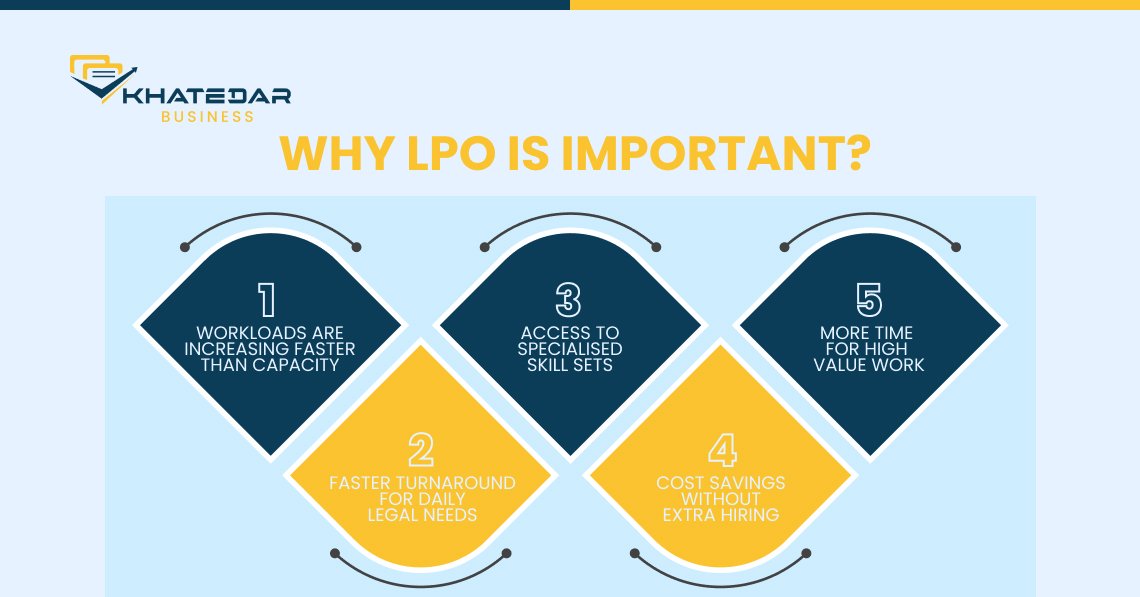
Legal teams today deal with growing workloads, tighter deadlines, and rising client expectations. LPO steps in as a practical way to manage this pressure without overwhelming in-house teams.
1. Workloads Are Increasing Faster Than Capacity
There is a constant rise in the number of tasks that legal departments have to do, yet the in-house teams aren’t always capable of handling them. LPO provides trained professionals who take over routine or high-volume work.
2. Faster Turnaround for Daily Legal Needs
Clients want their issues to be solved quickly. LPO teams are well-organized and self-managed with the ability to work around the clock, thus enabling firms to reduce legal service delivery times without quality having to be compromised.
3. Access to Specialised Skill Sets
It’s rare to find a department with top-notch experts in every discipline like eDiscovery, compliance, IP, or research. With LPO, you bring in the right talent that can excellently perform these tasks.
4. Cost Savings Without Extra Hiring
It is costly to keep house specialists for all tasks. Outsourcing cuts the cost by having a dedicated team that is already equipped with the right tools and skills.
5. More Time for High-Value Work
In-house teams will have more time to attend to the strategic legal matters and engage with clients if they concentrate on high-value and client-facing work by delegating routine tasks to LPO providers.
Benefits of Partnering with Legal Process Outsourcing Companies
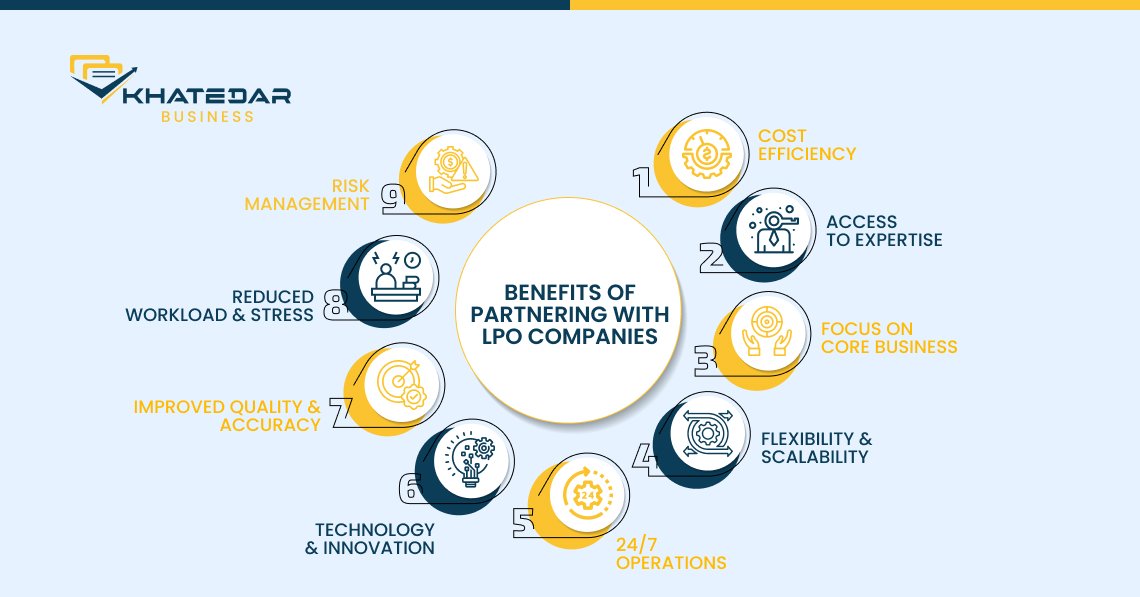
1. Cost Efficiency
LPO provides you with an opportunity to cut down on your expenses for hiring, training, and infrastructure. As a result, you can have a team of highly skilled professionals for less money than the cost of developing a team in-house.
2. Access to Expertise
You also get to work with trained professionals specialized in research, drafting, CLM, eDiscovery, compliance, and other areas that you are short of internally.
3. Focus on Core Business
Internal teams can now concentrate more on strategic cases, intricate legal work, and client interests rather than on routine tasks.
4. Flexibility & Scalability
When there is a sudden increase in the workload or the deadlines become tight, LPO teams can adjust to the new situation very easily, without the need for hiring or getting temporary staff.
5. 24/7 Operations
With cross-time-zone teams, work continues even after your office closes, helping you deliver faster results.
6. Technology & Innovation
LPO companies implement cutting-edge technologies such as AI, automation, and research databases to minimize the time taken by repetitive tasks and to enhance the accuracy of their work.
7. Improved Quality & Accuracy
Standardised workflows and quality checks help reduce errors and keep documentation clear, accurate, and compliant.
8. Reduced Workload & Stress
Your team isn’t overwhelmed by admin-heavy tasks. Outsourcing lightens the load, making operations smoother and more organized.
9. Risk Management
Risks that arise from errors or missed deadlines are eliminated by having experts already responsible for research, litigation compliance, contracts, and documentation.
And the best part? Khatedar Business brings all these benefits together, giving you a reliable, efficient, and cost-effective LPO partner you can trust.
Final Thoughts
Legal work has become more complicated, faster-paced, and more challenging than ever. This is why Legal Process Outsourcing has evolved from a backup option to a strategic necessity.
By outsourcing the right legal tasks, firms and legal departments can reduce workload, control costs, improve quality, and focus more on high-value legal work. It’s not about replacing your internal team, it’s about supporting them with the right expertise and resources.
Khatedar Business offers you a reliable Legal Process Outsourcing service that combines efficiency, expertise, flexibility, and reliability all in one place. Whether you are handling an increase in workloads or seeking to optimize your legal operations, LPO can assist you in working smarter and remaining competitive.
Stay connected, we’ll continue sharing practical insights and updates to help you navigate the evolving world of legal outsourcing with confidence.
FAQs
Q- What is Legal Process Outsourcing?
A- Legal Process Outsourcing (LPO) is the practice of assigning legal tasks to an external service provider instead of handling everything in-house. These tasks can include legal research, document review, contract management, compliance support, and more. It helps legal teams save time, reduce costs, and improve efficiency.
Q- What is outsourcing, and why is it important?
A- Outsourcing means handing over specific business tasks to an external expert. It is important because it allows companies to focus on their core work, reduce operational costs, and access specialised skills without expanding internal teams.
Q- What is an example of LPO?
A- A common example of LPO is outsourcing document review or eDiscovery during litigation. Instead of assigning large volumes of documents to in-house lawyers, an external LPO team handles the review efficiently and accurately.
Q- What is the purpose of LPO?
A- The main purpose of LPO is to reduce workload while maintaining quality and accuracy in legal operations. It allows legal teams to focus on complex legal matters while routine and time-consuming tasks are handled externally.
Q- What is the future of LPO?
A- The future of LPO looks strong as more organisations adopt technology-driven and flexible legal solutions. With the rise of automation, AI tools, and global collaboration, LPO will continue to play a key role in modern legal operations.
Q- What are the risks of using LPOs?
A- Potential risks include data security concerns, communication gaps, or quality inconsistencies if the provider is not chosen carefully. These risks can be minimised by partnering with a trusted LPO provider that follows strict security standards and quality controls.